Existing Basements – What The British Standard Recommends
BS 8102:2022 states that every existing basement will face water pressure at some point in its life. No one can predict when this will happen because future rainfall, watercourse changes, and burst water mains remain unknown variables. It’s risky to assume water will never exert pressure on a basement.
We also cannot predict the magnitude of that pressure. For this reason, the Standard advises the designer to expect—and design for—a full head of hydrostatic water pressure in almost every case. At some point, the soil around the basement can become fully saturated, and water can pressurise the full height of the structure.
So how do you protect against such a scenario?
‘Type C’ Cavity Drain Waterproofing Explained
BS 8102:2022 defines Type C waterproofing as “drained protection”. The approach receives incoming water within internal voids formed by cavity drain membranes and strategically positioned drainage channels on the floors and walls. The system depressurises that water as it enters and then moves it safely out of the building.
Because Type C waterproofing is maintainable and reliable, professional waterproofing contractors often choose it as the safest method. Designers also frequently include Type C within combination waterproofing strategies for both existing and new basement structures.
The Newton CDM System is a maintainable Type C solution built on decades of Newton waterproofing expertise. It includes high-quality, BBA-certified membranes with dedicated pumping systems, battery backup and telemetry. This proven approach has transformed hundreds of existing basements into dry, usable living spaces.

Where an internal block wall sits in front of the cavity drain system, this detail shows one example of how to design the waterproofing.
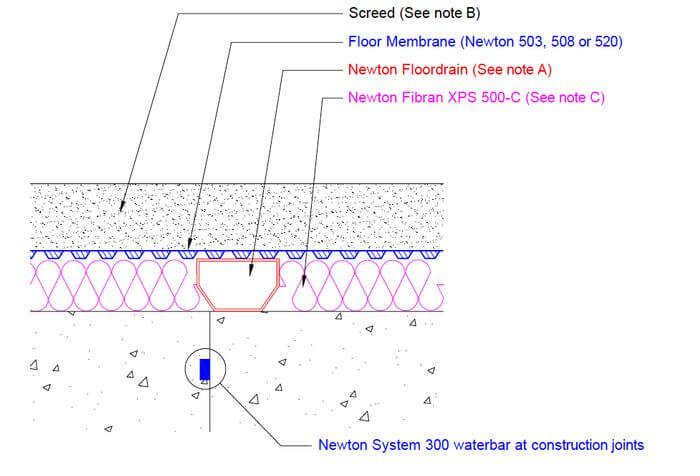
Newton CDM FloorDrain channels sit above construction joints in the slab or raft to capture water that enters through these junctions.
The Importance of Maintainable Waterproofing
The Newton CDM System uses drainage channels at structural weak points, including slab joints and the perimeter where the slab meets the wall. These channels intercept water at these locations and route it safely out of the building.
Most projects use a sump chamber to collect this ingress, and a pump removes the water mechanically. On sloping sites, gravity can discharge the water to a lower collection point. A key strength of the Newton CDM BaseDrain is full maintainability, aligning with BS 8102:2022 recommendations.
Strategically placed inspection ports allow inspection, cleaning and targeted remedial work without major disruption. This ensures the design considers remedial feasibility from the outset, as BS 8102:2022 requires.

“CCL would, without doubt, recommend Newton Waterproofing Systems. Our relationship goes back a long way and we have always received a 5-star delivery service to site for our specialist applicators and excellent technical advice for all aspects of structural waterproofing. They always go above and beyond.”
Jamie Tschumi — Director, Cast Contracting Ltd
Newton Specialist Basement Contractors
Newton Specialist Basement Contractors (NSBC) form an elite group of professional structural waterproofing and damp-proofing contractors. They partner with Newton to deliver high-quality products, robust designs and expert installation across domestic and commercial projects.
NSBCs take responsibility for both design and installation, and they provide meaningful, insured installation guarantees for their work.
Technical Drawings
Newton maintains an extensive library of Technical Drawings for basement waterproofing projects. You can download drawings in both PDF and AutoCAD formats from the Technical Drawings area.
If you’d like to discuss your project with a waterproofing expert, our Technical Team provides objective advice and guidance by phone or email.